
A basketball franchise simulation lets you explore how player and team scenarios might play out across a game or a season. SwishIQ Studio, from DJ's House of Cards & Comics, brings together player dossiers, historical data, Forge ratings and skill profiles, lineup analysis, chemistry tools, game and season simulations, and daily challenges. These features give fans different ways to examine basketball questions; they are not all the same kind of evidence or result.
The key is to know what each result means. Historical records describe what happened; ratings and chemistry analysis are modeled views; a simulated result is an output from a model, not a forecast of what will happen next.
What a Basketball Franchise Simulation Models
A franchise simulation models a team as a set of players whose skills and roles can be considered together. Instead of focusing on one athlete’s career, you can explore team-level questions: how player profiles compare, what skills a lineup appears to bring together, or what a modeled matchup or season result looks like.
SwishIQ Studio supports this kind of exploration with distinct features. Player dossiers and historical data provide player and career context. Forge ratings and skill profiles offer a modeled view of player attributes. Lineup analysis and chemistry tools add team-level perspectives, while game and season simulations produce modeled outcomes. Daily challenges offer another interactive way to engage with basketball questions. These features can complement one another, but a historical record, a rating, chemistry analysis, and a simulation result are not interchangeable.
The engine is a simplified model of basketball. A simulation result depends on the information and rules the model uses, along with any variation built into it. The available features support exploration of player and team scenarios, but a model cannot reproduce every moment, decision, or circumstance of a real game.
For example, a fan might examine two player dossiers to compare their historical context, then consider how their Forge skill profiles differ. Another question might be how a group of players is represented by lineup analysis or chemistry tools. A game or season simulation can offer a separate modeled outcome to explore. These are useful ways to investigate an idea, not proof that a real team would perform in the same way.
For collectors, the useful connection is between on-court analysis and the athletes whose cards they collect. A player dossier or a historical comparison can add context to a collecting decision. It should not be read as an appraisal. A simulation result does not establish a card’s market price, grade, authenticity, or future value.
DJ's House of Cards & Comics describes SwishIQ Studio as a sports analytics and simulation suite for exploring the game beyond the box score. Its SwishIQ Studio page is the place to start if you want to explore the available basketball tools directly.
Keep one distinction in mind: the model can help you ask a better question, but its output remains a model result. That matters even more when you use historical players or compare seasons from different eras.
How Rosters, Contracts, Drafts, and Trades Shape a Franchise
Roster building is a useful way to think about team fit, even when you are not managing a full front office. A group of strong scorers may still appear to lack ball handling or defensive coverage. Several players may also have overlapping strengths or roles. A useful question is not only “Who is best?” but “What does this group appear to offer, and what might it be missing?”
In some franchise-management games, contracts, salary rules, drafts, trades, and free agency shape which players a team can keep or add. These are common genre concepts, but they are separate from the SwishIQ Studio features described here. Do not assume that a basketball simulation or analysis tool includes those front-office systems.
SwishIQ Studio’s established features center on player dossiers, historical data, Forge ratings and skill profiles, lineup analysis, chemistry tools, game and season simulations, and daily challenges. These can help fans explore player comparisons and team scenarios. They should not be treated as a contract negotiator, draft tool, trade engine, or free-agency system.
Scouting and drafting also involve uncertainty. A rating can summarize a player’s modeled skills, but it cannot guarantee how a prospect would develop in a different role. When comparing a prospect with a veteran, first consider what kind of information you are looking at: historical production, a skill profile, lineup analysis, or a simulated contribution. These are related questions, not interchangeable answers.
Contracts and budgets matter in a simulation only when the engine models them. If a tool does not include payroll, a lineup comparison cannot tell you whether a roster is financially workable. Keep that boundary clear rather than reading a basketball result as a complete front-office plan.
Collectors can use player comparisons to decide which names or eras they want to learn more about. DJ's House of Cards & Comics has a dedicated basketball card collection with rookies, stars, inserts, parallels, autographs, and memorabilia cards. Browse by player or set when a simulation sparks interest, then assess the card itself on its own terms.
For a practical example, a fan might ask how two groups of players differ in their profiles, lineup fit, or chemistry analysis. A game or season simulation can provide another modeled perspective where the available tools support that question. Keeping the question focused makes it easier to understand which kind of result you are considering.
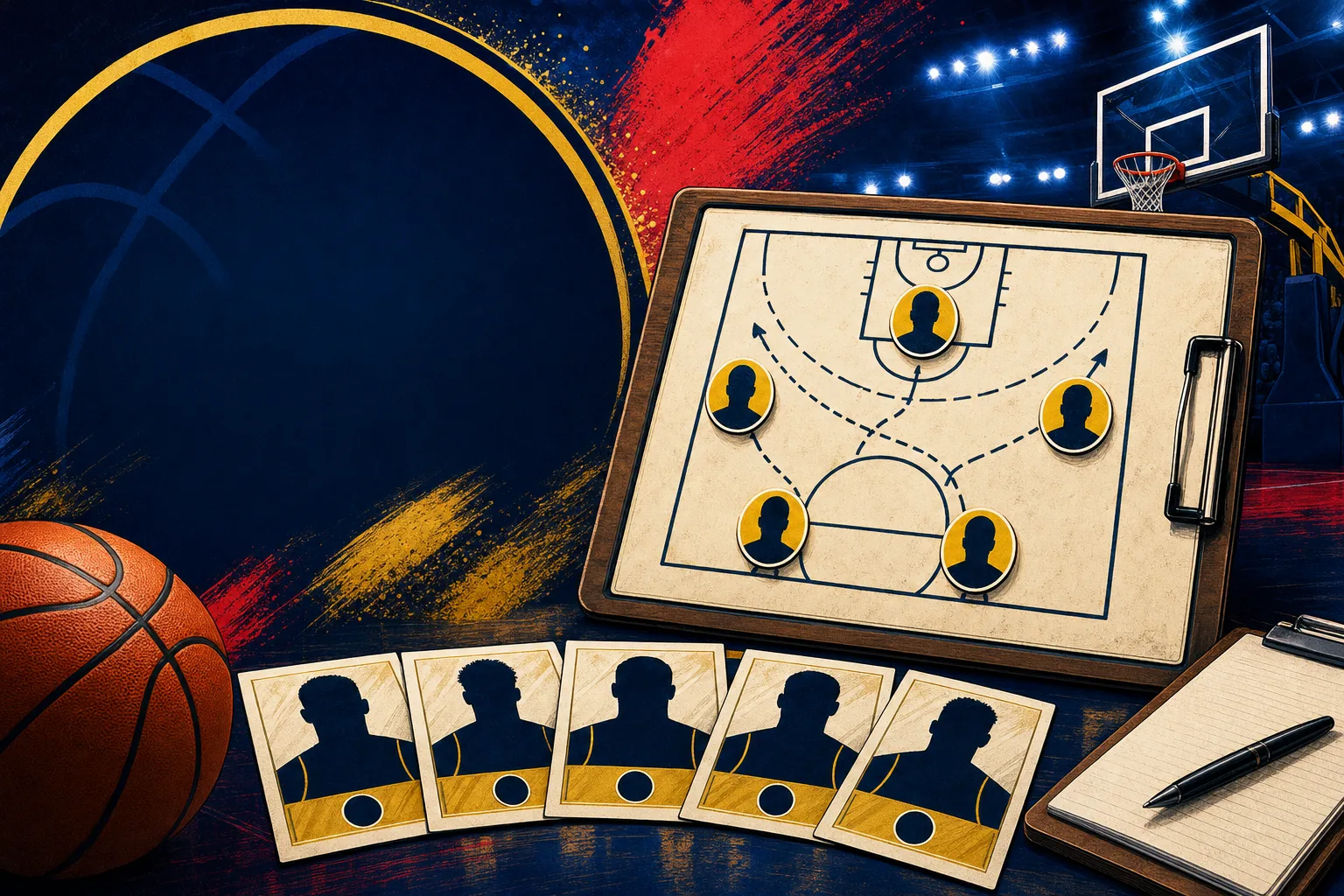
How Ratings and Game Engines Produce Results
A rating turns several player traits into a shorter summary. That can make comparisons quick, but the number depends on the traits included and how the model weighs them. Two systems can rate the same player differently because they use different inputs or definitions.
Some performance measures need context. Per-game totals can rise because a team plays at a faster pace or a player gets more minutes. Per-possession measures help adjust for pace. Shooting efficiency also needs care: a made three-point shot is worth more than a made two, so field-goal percentage alone does not show a player’s full scoring efficiency.
Usage is another example. It describes how often a player ends a team possession while on the floor. It does not mean the player is good or bad. A player’s efficiency may change when their role grows, so a rating built from past performance should not be treated as a guarantee about a new role.
Forge ratings and skill profiles in SwishIQ Studio give fans a modeled way to examine player attributes. Player dossiers and historical data provide different kinds of context, while lineup analysis and chemistry tools consider players in a team setting. Looking across these features can make a comparison more informative than treating any single number as a complete verdict.
Think of a game engine as a model that uses information and rules to return an outcome. Player data, ratings, and team scenarios may be relevant to the analysis, but the exact mechanics and weighting should not be assumed unless they are stated by the tool. A simulated score or season result tells you what the model produced for the scenario; it does not prove that the same outcome would occur in a real game.
There are limits. A composite rating can hide its own assumptions. Defensive value can be hard to capture with simple box-score measures. Historical data may also be uneven across players and eras, so comparisons need care.
When you read a result, ask what kind of information it represents and what question it addresses. Historical data records past performance; Forge ratings and skill profiles are modeled assessments; chemistry analysis is a modeled view of a group; simulation outputs are outcomes produced by the model. Keeping those categories separate helps you interpret what SwishIQ Studio can—and cannot—show.
From One Game to a Full Season and Playoff Run
A game simulation can be useful for exploring a focused matchup question. A fan might be curious about how a modeled result compares with their expectations for two teams or groups of players. A season simulation asks a broader question by returning an outcome across a longer modeled run.
More games add more chances for variation to affect the record. A close result in one game may look different over a season, but a longer run still depends on the model’s assumptions. It does not become a prediction simply because it covers more games.
SwishIQ Studio includes game and season simulations, alongside player dossiers, historical data, Forge ratings and skill profiles, lineup analysis, and chemistry tools. Those features give fans different perspectives for exploring basketball scenarios. Historical records describe what happened, modeled ratings and analysis describe how the tool represents players or groups, and game or season simulations return model outputs.
Use this distinction when you study a season result:
| What you’re looking at | What it can help you examine | What it does not establish |
|---|---|---|
| Historical data | Recorded player or season information | How a different lineup would have performed |
| Player rating | A compact view of modeled skills | A universal ranking across every system |
| Lineup analysis | How selected players fit within the tool’s model | Guaranteed success in live competition |
| Game simulation | One modeled matchup or scenario | A certain result for a real game |
| Season simulation | A modeled run across a longer schedule | A forecast or promise about a real season |
Playoffs make the same caution useful. A short series can turn on a small number of modeled outcomes. If you are exploring a playoff-style question with the available simulation features, read the result as a way to examine a scenario, not as a claim about a future bracket.
Era comparisons need an extra check. Rules, roles, pace, and available records can differ by period. Historical data can put players in context, but it does not erase those differences. A comparison is clearest when you know whether you are looking at recorded statistics, modeled ratings, lineup analysis, or a simulated matchup.
For a fan, the most productive approach is to start with a clear question, identify the kind of information or result that addresses it, and consider what the model does and does not establish. If a season output differs from your expectations, treat it as a prompt to examine the scenario—not as proof that a real team would achieve that record.
Why Chemistry, Rotations, and Coaching Decisions Matter
A roster is more than a list of player ratings. Roles and minutes shape who handles the ball, who spaces the floor, and who has to cover a defensive job. Those concepts can help you frame questions about how players might fit together, even when you are examining a lineup rather than managing a full team.
SwishIQ Studio’s chemistry tools add a modeled team perspective. They let fans explore how a group is represented within the tool, but a chemistry analysis cannot capture every relationship or choice in a real locker room. Read it alongside the player profiles and lineup context rather than as a complete explanation of team performance.
Rotations also affect statistical comparisons. A player who receives more minutes can collect more points or rebounds, even if their per-minute production stays similar. When comparing two players, check whether their roles and playing time are alike. If not, raw totals may tell you more about opportunity than skill.
Coaching decisions shape roles and minutes in many franchise games. However, SwishIQ Studio’s described features are player dossiers, historical data, Forge ratings and skill profiles, lineup analysis, chemistry tools, game and season simulations, and daily challenges. Do not assume the studio includes coaching or rotation-management controls beyond those stated features.
Here is a practical question to investigate: how do two player profiles differ, and what might those differences mean when considering their lineup fit or chemistry analysis? A fan could use the available features to explore those related perspectives, while remembering that each represents a different kind of information. Do not assume that a particular sequence of controls or a specific lineup-management workflow is available.
That process can also help collectors explore a player’s role. A card subject may be known for a specific skill, and a player profile or team analysis can provide context for how that skill is discussed alongside other players. The result can add interest to a comparison without turning a model rating into a grade or price estimate.

Keep the question grounded in the evidence you are using. If you are considering chemistry analysis, distinguish it from historical statistics and simulated outcomes. Clear categories make it easier to interpret what each feature contributes.
How to Read Simulation Results—and Where SwishIQ Studio Fits
Start by identifying the question. Are you comparing player histories, examining Forge skill profiles, considering lineup fit or chemistry, or exploring a modeled game or season result? Knowing the question helps you choose the right kind of information and avoid treating one feature as an answer to another.
Next, separate the kinds of information. Historical data describes recorded performance. A Forge rating or skill profile is a modeled assessment. Chemistry analysis reflects the tool’s modeled view of a group. A simulated score or season outcome is an engine output. Keeping those labels distinct helps prevent an estimate from looking like a fact.
Then ask whether the information answers your question. If you want to compare a player’s historical career, a game simulation may not be the right measure. If you want to explore a team scenario, a career total alone may not address lineup fit. Match the kind of tool or result to the question before interpreting it.
SwishIQ Studio is for fans who want an interactive way to examine players, data, and team scenarios. DJ's House of Cards & Comics describes the suite as combining player dossiers and historical data with Forge ratings and skill profiles, lineup analysis, chemistry tools, game and season simulations, and daily challenges.
For card collectors, this can make research more engaging. You can begin with a player or an era, consider the available profile and historical information, and explore relevant team questions through lineup, chemistry, or simulation features. The studio connects basketball analysis with collecting interests, but it should not be mistaken for a card appraisal or a live market feed.
When a result surprises you, do not accept it at face value. Consider what kind of output you are seeing, what it can represent, and what it cannot establish. A simulation can help you explore a question, but it cannot prove that a real team would get the same result.
A useful habit is to keep three notes: the question you asked, the type of information or result you considered, and what you learned from it. That small record makes comparisons easier to revisit and helps keep a simulation from being quoted later without the context that produced it.
Across basketball, football, and baseball, SwishIQ Studio gives fans interactive ways to examine players and data. Basketball remains the focus here, but the same reading rule applies across sports: separate recorded history from modeled analysis and simulated outcomes before making a claim or a collecting decision.
Basketball Franchise Simulation FAQ
What is a basketball franchise simulation?
A basketball franchise simulation is a model that uses player or team information to produce game or season outcomes. It focuses on team-level questions rather than controlling one player’s career. In SwishIQ Studio, game and season simulations sit alongside player dossiers, historical data, Forge ratings and skill profiles, lineup analysis, chemistry tools, and daily challenges. Results depend on the model and should be read as simulation outputs rather than guaranteed predictions.
Does SwishIQ Studio simulate full basketball seasons?
Yes, SwishIQ Studio includes season simulations as well as game simulations. Fans can use those tools to explore modeled basketball scenarios, while player and team analysis features offer other perspectives. A season result is still modeled, not a forecast of a real league. Consider what kind of result you are viewing before drawing conclusions from a simulated record.
Are SwishIQ ratings the same as historical statistics?
No. Historical statistics describe recorded performance, while a Forge rating or skill profile is a modeled summary. SwishIQ Studio includes historical data as well as Forge ratings and skill profiles, so keep those categories separate when you compare players. A rating can help frame a question, but it is not a replacement for the underlying record.
Can a simulation tell me what a basketball card is worth?
No. A simulation result is not a card appraisal. It can add context about a player’s performance or role, but a card’s condition, grade, authenticity, scarcity, and demand are separate collecting factors. Use sports analysis to guide your research, then assess the individual card and its market context independently.
Can I use a simulation to compare players from different eras?
You can explore cross-era player questions when the available historical data and tools support them. But differences in rules, roles, pace, and record quality can affect the comparison. Check whether you are considering historical statistics, modeled ratings, or a simulated scenario, and treat the result as an analytical exercise rather than a definitive ranking.
Conclusion
Use SwishIQ Studio to explore player profiles, historical context, lineup fit, chemistry analysis, and modeled game or season scenarios as distinct ways of examining basketball. Start with one question, consider what kind of information addresses it, and keep simulated results separate from historical facts and card values. The tools can make basketball research more interactive, but their outputs are not predictions or appraisals.